The Cycles of the God and Goddess Through the Wheel

imgres

The Cycle of the God and Goddess

The Cycle of the God and Goddess within the Wheel is one that mirrors the cyclical nature of our spiritual growth and the life stages we move through in the course of our lifetimes. The Goddess is the Maiden of new beginnings and the gift of promise who becomes the nurturing Mother. She tends and cares for what she has birthed and as Her wisdom grows she enters the state of being that is the wise Crone who has seen all that life has to offer and gives that wisdom back to those who prove worthy. She remains a constant throughout the wheel, never dying or being reborn; changing only in the nature of expression that is necessary to ensure the cycle of the God.

The God also moves through the cycle of death and rebirth, and His course is that of sacrifice, death and then the mastery of rebirth. He moves through the Wheel as both child and lover to the Goddess as well as guardian and protector of both flora and fauna. Throughout his cycle of change he moves from the child of Light that is birthed at Yule to the Youth that quickens and enlivens at Beltane to the King of Power and Father of strength at Litha and finally to the place of the Sage whose energy sustains humanity in the harvested grain, cut down, and willingly sacrificed to feed and hold all safe throughout the cold of winter.

The Cycle of the Goddess
Young Mother (Imbolc) – Maiden(/Spring Equinox/Beltaine) – Pregnant Mother (Summer Solstice)- The Harvest Mother (Lammas/Autumn Equinox) – The Crone who holds the seed of the quickening God of Light – (Samhain)

and

The Cycle of Life, Death and Rebirth of God
Growing Youth (Imbolc/Spring Equinox)) – Virile Young Man (Beltane) – The Father (Summer Solstice) – Sacrificial Father/Protector (Lammas)- The Sage (Autumn Equinox) and the Quickening Seed held within the womb of the Crone (Samhain)

If we follow this cycle through the Wheel of the Year, these are the attributes of Deity that are held within. This is but one interpretation of the cycle of God and Goddess:

Imbolc: Quickening

The Goddess, after giving birth at the Winter Solstice begins her transformation and renewal into the Maiden. The time of ripening and fertility

Spring Equinox: Balance/Transition

As the God is gaining in his strength and growth the Goddess is both the nurturing Mother and the quickening Maiden. This is an aspect of the Equinox as a process of transition and transformation. The energy of this balance calls forth the renewal of the Goddess into the eager Maiden anticipating the sacred union at Beltaine.

Beltaine: Procreation

The Goddess, now fully clothed in the aspect as the Maiden is ready to procreate and continue the cycle of life. The God has now reached the stage of the virile and potent Youth and their sacred union will provide the promise of what may be reaped later in the cycle of the Wheel.

Summer Solstice: The Great Mother

The Goddess is pregnant and ready to give birth. She is at the apex of motherhood; and the potential for life that the Mother offers. The God has reached maturity and holds the potency of his being sustaining and providing as the Father.

Lammas: Sacrifice

The Goddess is now seen as the Earth Mother. That which was planted as seed and quickened at Imbolc comes to full harvest and it is now time to reap the fruits of what has been planted to continue the cycle. The God in his matured aspect of the protective Father holds within the knowledge that His cycle of strength and light will be renewed only if he willingly sacrifices his life to ensure that all life will continue through the harshness of the winter months ahead. He is the wheat that is harvested to nourish.

Autumn Equinox: Transition to Wisdom

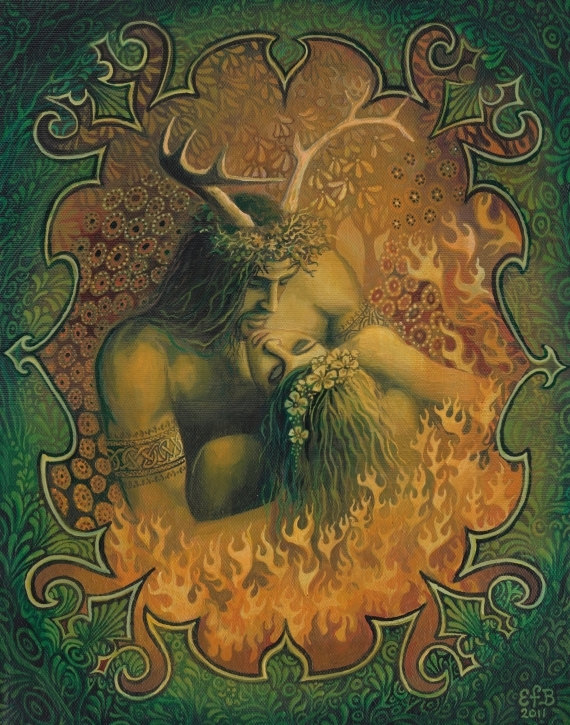
The Goddess, recently widowed through the sacrifice of the God at Lammas, now mourns this loss of her consort and she enters into her time of wisdom of the Crone. The God, now having become assimilated by and completely part of the natural world, is seen as the Horned God or the wild protector of natural life. He asks that we take only what is needed for survival and that we hold in reverence the dormant potential that lays within for new life at the time of the Spring Equinox.

Samhain: Promise of Renewed Life through Death

The Goddess as the Crone is the wise one that knows the mysteries of the sacred cauldron of life/rebirth and carries the lessons of the Mother within; transforming them into deeper wisdom. It is from this deep place of knowing and the waters of the sacred womb that the Goddess becomes pregnant with the sun child who is the God to be born at the Winter Solstice. This is the polarity of Death ( God /Consort had to be sacrificed (grain/harvest) in Life ( the sun child sleeps still in the womb of the Goddess ready to be born at Solstice ).

Winter Solstice: Rebirth

The Goddess, transformed once again in the Great Mother gives birth to the Sun King, the God. This is the promise of renewed Life and the return of the Sun’s warmth and sustaining energy. This is the affirmation of Life (birth of Sun) that is held In Death (the dark of Winter when nothing seems alive).

Another Turn of the Wheel

As we learned in Lesson Three, The God is also depicted on the Wheel of the Year as the Holly and Oak King, at the Solstices (Litha and Yule), respectively. In this cycle of the Wheel the God is directly responsible for the Natural World and the creatures that inhabit it. In keeping with this attribution the God at Lammas still acts as the Sacrificial King and the lands that he has guarded and greened throughout the Summer as the Oak King are now needed to feed and provide the harvest for those of humankind who are also in his keeping. The wheat is cut and the bread is baked to honor this willing sacrifice and the ingestion of this substance of Life is the ingestion of the solar and life giving principles of the God himself.

The Holly King and Oak King

Each holds sway and hand of might
Upon the year’s Great Wheel.
In each domain one shall be King
As wax and wane of Light
Move within nature’s cyclic plan.

The Oak holds fast
To growing light
And Holly brings shadow near.

The time between held
In equinox Gate and season’s turn
Tips finely calibrated scales.

Solstice Kings, though brothers, they
In battle determine solar fate.

The Light holds fast
The Oak marks time
Flanked by strength
And sundial’s grace.

The Holly answers with response
A dance of calculated pace.

At sunset’s call, he strikes his final blow
As Oak in silent acquiescence bows
And bends to Summer Light’s repose.

His brother- triumphant Holly King
Upon rooster’s call shall next arise.

The waning of the year begins
With Oak King’s necessary demise.

For what lay sleeping within
The growing splendor of Holly’s
Fertile embrace is the promise
Of Light’s return at the peak of
Winter’s darkened and snowy face.

And, once again the two shall meet
Oak strengthened by slumber’s rest.
The end of darkness near;
The Holly King, his energy spent
Shall relinquish crown as
Oak reigns renewed.

The Oak King and the Holly King are part of Celtic mythology, and are often seen as aspects of the Green Man. They are usually considered “twin gods,” or sometimes two aspects or manifestations of the same god, often the Horned God. The Oak King rules the Summer months (and is sometimes called the “Summer King”) and the Holly King rules the Winter months (and is thus called the “Winter King”). The God in this form acts as guardian and keeper of the natural world through its cycles of waxing and waning light. He ensures that all will be well and all will continue and be sustained.
imgres

The Oak King is usually celebrated at Yule and heralds the return of the Light, spring and new growth and the Holly King is generally celebrated at Litha, as the Light begins to lessen in preparation for harvest and winter. A battle is enacted at those times and the victor of the new season takes his place as guardian. They are twin reflections of an inner polarity of Light and Dark and the battle that takes on the inner landscape as we move towards acknowledgement and embracing of our own Divine nature.

Foundations of Practice: (Available on Thursday)
Meditation
A Pathworking of the Season

Next Post
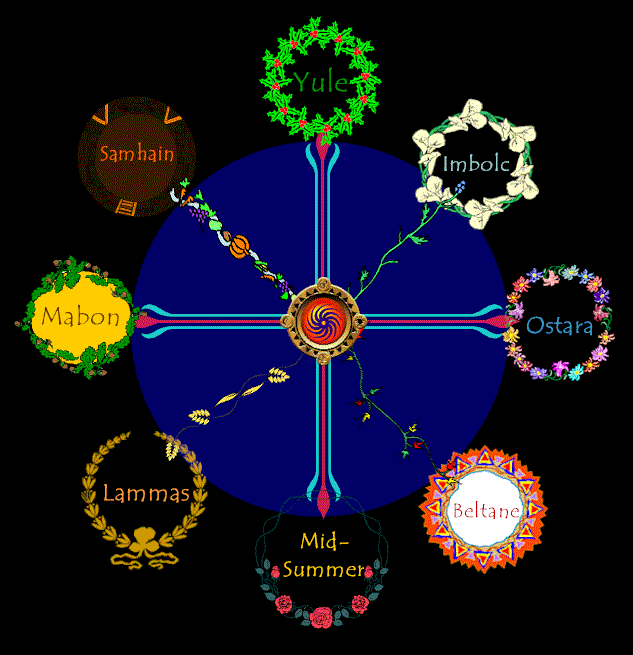
The Eight Sabbats of the Witch’s Wheel of the Year
2zivk90


Posted in YAD-Lesson Four, Year and A Day Course | Tagged , , , , , | 12 Comments

The Cycles of the Wheel

wheel-of-the-year

To everything – turn, turn, turn
There is a season – turn, turn, turn
And a time for every purpose under heaven

A time to be born, a time to die
A time to plant, a time to reap
A time to kill, a time to heal
A time to laugh, a time to weep

To everything – turn, turn, turn
There is a season – turn, turn, turn
And a time for every purpose under heaven

A time to build up, a time to break down
A time to dance, a time to mourn
A time to cast away stones
A time to gather stones together”

…Lyrics by The Byrds…

There are several cycles that can be used to describe the energy of the movement of the Wheel and how it aligns with the natural world. All are occurring interwoven and simultaneously, even though it may appear that in a particular ritual one or another may be more apparent. Below is a brief listing of a few of these cycles:

The Cycle of the Seasonal Tides
The Cycle of the Growing/Hunting and Gathering Year
The Astronomical Cycle.. The Equinoxes and Solstices
The Cycle of the Waxing and Waning Year… Light/Dark
The Astrological Cycle
The Cycle of God and Goddess… Birth, Sacred Union, Maturity, Death, Rebirth


The Cycle of the Seasonal Tides

fourseasonsoneday

The seasonal tides align with the agricultural activities and the space of rest from the labor and efforts of survival.

Tide of Sowing
Spring Equinox through Summer Solstice

Tide of Harvest
Summer Solstice through Autumn Equinox

Tide of Reflection (Moving Within)
Autumn Equinox through Winter Solstice

Tide of Turning Overs (Beginning Anew and Quickening)
Winter Solstice through Spring Equinox


The Astronomical Cycle

solstice

The Astronomical cycle marks the cosmic balance of abundant flow and balanced synthesis of energetic outpouring. These are also pivotal times for growth. The states of balance that occur during the equinoxes offer opportunity for synthesis and pause. These are the “between” times and breathing into the space of this energy becomes an opening to the silence of deep wisdom that fills and flows through us.

The markers of the Solstices, give sway to one form of energy over the other and allowing its abundant gifts to flood through as bolster and support that refines and reshapes what it is applied to. This is the action of expansion and contraction and the incremental movements forward that this motion creates. This action is much like that of the tiny hair like projections of cilia in our bodies that rhythmically beat out a pulse that carries waste material out of the body. Those aspects of our growth that are no longer productive are then further modified and kept or released as the energy of the equinoxes exacts its refinement.

The Equinoxes and the Solstices

The Equinoxes: Time of balance between light/dark

Vernal Equinox – Spring and the season of rebirth. All things are now in their phase of growth, having passed through the periods of quickening and ripening.

Autumnal Equinox – Autumn and the season of release and harvest. All things have now passed their peak and what has been gathered makes way for what will be planted later.

The Solstices: Time of Transition

Winter Solstice/Yule – Marks the point of the longest night and the hope of the sun’s return as the days’ become longer from here forward until the
Summer Solstice/Litha – Marks the point of the longest day and the beginning of the winter and dark months ahead until the Winter Solstice begins the cycle once again


As the Wheel Turns..
The Waxing and Waning of the Year

Screen Shot 2013-01-15 at 12.27.34

Within each half of the year, waxing and waning the equinoxes provide a place of balance. This is the cycle of polarity, light and dark, increase and decrease. The Light or Waxing half of the year begins at the Winter Solstice. Having completed the place of maximum length of darkness, the time of daylight begins to slowly increase day by day. We move through this stage of increasing light passing through Imbolc, the celebration of increase and quickening of the spark of fire and light that was birthed at Yule. The Spring Equinox offers a space of synthesis and equanimity and is the mid-point achieved during this increase of daylight. As the fires increase and the heat and intensity of light continue in their increase Beltane signals the time of rutting, courting and active creation. The intensity of this effort and action culminates at the Summer Solstice. The Peak of the length of daylight, heat and ripening fruits of what was planted.

Upon reaching the Summer Solstice, the Dark or Waning Half of the Year begins. The harvests are ready to be gathered and the sacrifice of the grain and any animals needed to ensure food through the winter is celebrated at Lammas. As the length of daylight continues to decrease the mid-point of the waning cycle occurs at the Autumnal Equinox. This is a time of pause from the business of harvesting and hunting and giving thanks to all that has willingly sacrificed its life to ensure humanity’s. Samhain brings the shroud of darkness that will prevail in the cold months ahead and the time to move inside and turn within to hearth and home is at hand. At the darkest hour of the longest night the hope and promise of the return of the sun and new cycle of renewed life is held in reverence on the eve of the Winter Solstice. Imbalance gives way and the cycle of Waxing and Waning begins anew.

The Light Half of the Year

Waxing 

Winter Solstice
Yule
Beltane                           Imbolc
    Union                              Quickening
Spring/Vernal Equinox
Place of Balance

The Dark Half of the Year

Waning 

Summer Solstice
 Litha
Samhain                           Lammas
Promise/Potential               Sacrifice
Fall/Autumnal Equinox
Place of Balance


The Astrological Wheel of the Year

AstroWheelYAD

Looking at the Wheel from an astrological perspective provides a way of also learning new overlays of correspondence for the study and application of Astrology. In this pattern, we begin our journey in the astrological sign of Aries, the first of the Zodiacal wheel and the date of the Spring Equinox. Aries is of the Fire element and represents the initial action of the fires of creation. Ostara is the celebration on the Wheel and heralds Spring, new growth just emerging from frozen and cold earth and the promise of warmth and the full blossoming of things to come.

The next Sabbat of Beltane occurs in the zodiacal month of Taurus and Earth sign. Beltane celebrates the sacred union of Goddess and God. This is the pivotal point of consummate action to insure viability of creative product. The symbol for Taurus is the Bull and his energy is one of potent fecundity and the striving for secure physical space of dwelling. Taurus is the sign of safe-guarding an as in the case of the Sabbat, the union of male and female is the safe-guarding of the promise of renewed and sustainable life.

The time of gathering information and disseminating that information occurs as Gemini, the astrological sign of communication moves into place. Seasonally, we could consider this the time when all of plant life is getting its wake up call, the weather s warming and the word is out that creation and life are ready and able.

When we reach the Sabbat of Litha/the Summer Solstice the heat and abundance of June is at hand. This timing heralds the transition from communicative Gemini into the nurturing watery and emotion-filled sign of Cancer. Gemini spends the last bit of its energy communicating all of the vital information needed to home-loving Cancer as the Waning of the Solar Year begins and the healing of release of the dominant Sun is required as darkness begins to slowly overtake the length of daylight.

The three harvest, beginning with Lammas mark the space of transition from the last hurrah of the Sun’s energies in Leo, as the abundance of growth receives the energy of daylight to complete its cycle of fruition. As we move into Virgo’s gift of reorganizing, accountability and preparation for what is at hand this is the time of rest before the next harvest of the Autumnal Equinox/Mabon.

We welcome the dynamics of Libra’s balance and refined grace and what would normally be simply an intellectual (Libra is of the Air element) exercise is tempered by the temporary state of balance between heart and mind. The Autumnal Equinox engages the animal kingdom in the harvesting process and the God as Lord of the hunt and Guardian of the hunted, holds that balance in check offering up only what is needed to sustain humanity and the predators of his world. We are submerged in the space of shorter days and the night calls us more insistently to bring our light indoors and stoke the fires of hearth and home.

The reckoning that is exacted as Samhain’s fires burn and the call to Ancestral wisdom is held within the energies of the astrological sign of Scorpio. Scorpio is of the element of Water and its waters are both the incubator for what will be quickened and held within until the Winter Solstice and those that drown and submerge what needs release. Some are stored as shadow and memory and others are pulled into the sea of return as the Ancestors call to their own. Samhain is veil and shadow and the deeper mysteries of the Self and as October gives way to Novembers beginning chill we dig deeper into our own subconscious like the scorpion hidden and waiting to strike.

Time flows through Sagittarius as the fiery arrows of connection and seeking fertile ground are launched. These will be the tiny sparks that light the way for the blaze of brilliance that will emerge at the next turn of the wheel; finding us at the Winter Solstice and the beginning of the Waxing of the Year. Late December’s cold cautions of the need for warmth and security of dwelling space and the light that has been awaiting rebirth is now ready to come into manifestation. We call to the Sun Child to return to us and bring His promise of new growth in the months ahead. We call to the upcoming marking of the passing of the old and the start of a New Year to bless all of our endeavors. And the astrological sign of Capricorn begins its first steps as the goat stepping with assurance on the craggy surface of a sheer cliffside.

We move towards completion of one cycle of the Zodiacal Wheel as Aquarius provides the vision of what is possible with collaborative effort and proper use of the new light that has been birthed. Imbolc honors the quickening of this fire as it takes its place in the hearth of our Being. Brighid, is the Goddess most often called upon and her healing, creativity and forge of flaming strength are presented in the broad reaching mind of the Aquarius sun. This vision will nourish and support the young that have been birthed from its fires and the seeds still held in frozen state awaiting a deeper level of warmth in the compassionate waters of Pisces, the last of the astrological signs and the keeper of the wisdom of experience of all that has preceded it. Pisces is also the place of final release, having learned these lessons as its flows into the Fires of Aries, the first and catalyzing sign of the Zodiac. And, so the cycle begins anew and what is ignited moves into the Spring Equinox to receive the tempering of balance and strength from the foundation earth of Taurus.

Foundations of Practice:
Practical Experience: can You Feel It?


Next Week’s Post:

The God and Goddess Through the Wheel of the Year 

imgres

Posted in YAD-Lesson Four, Year and A Day Course | Tagged , , , , , , , , , | 7 Comments

Bonus Post- The Light of the Harvest

images

Please enjoy the new Lammas article featured on WitchVox this week as a preview of our upcoming lessons on the Sabbats!

The Light of the Harvest-Lammas

The Sythe of Light– Poem

Posted in YAD-Lesson Four, Year and A Day Course | Tagged | Leave a comment

Overview of the Lesson: 4-The Wheel of the Year

wiccawheel of the year

The Wheel of the Year…..

There was three kings into the east,
Three kings both great and high,
And they hae sworn a solemn oath
John Barleycorn should die.

They took a plough and plough’d him down,
Put clods upon his head,
And they hae sworn a solemn oath
John Barleycorn was dead.

But the cheerful Spring came kindly on’
And show’rs began to fall;
John Barleycorn got up again,
And sore surpris’d them all.
… Robert Burns …

What is the Wheel of the Year?

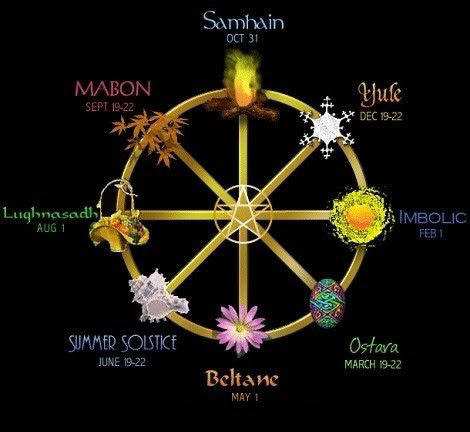
The Wheel of the Year is a reflection of the recurring cycles of the Natural world. Traditionally, these celebrations were very closely tied to the cycles of the agrarian culture of Western Europe and were marked by those specific seasonal rites of celebration. There are eight festivals or celebrations that mark the turning of the Wheel, the never-ending movement of time and the changing of the seasons and tides of nature.

The Cycles of the Wheel

The cycles represent birth, death and eventual rebirth and are symbolized through the continuum of life held within the mythos of the God and Goddess. The cycle of the God is one of sacrifice, moving from his birth at the Winter Solstice in the form of the return of the light (Sun) to his claiming of manhood and fecundity at Beltane to the sacrificial God of the Harvests at Lammas. The Goddess moves through her forms of triplicity- Maiden – Mother and Crone and remains as the undying one.

The Sabbats

Four of the Sabbats are known as the “cross-quarter” or Greater Sabbat celebrations, and include Imbolc, Beltane, Lammas and Samhain. The remaining four, or Lesser Sabbats mark specific astronomical positions of the sun. These are the Winter and Summer Solstices and the Vernal and Autumnal Equinoxes.

Reading and Resources:

This month we have a couple new book offerings that will offer ideas about how to create your own celebrations of the Wheel, give more information about the origins and cultural associations with the Sabbats and how to incorporate the energy of the Witch’s Wheel into your practice.

Life and its cycles are all around us.
Open your heart to the experience,
open your mind to the collective wisdom
and come dance the circle of the Wheel….

Blessings Bright on Your Journey..

What is the Wheel of the Year

Posted in YAD-Lesson Four, Year and A Day Course | Tagged , , , , , , , | 6 Comments

What is the Wheel of the Year?

Wheel what is

The Wheel of the Year marks the Sun’s journey across the sky, the solstices, equinoxes and the Earth’s changing seasons. Each spoke of the wheel marks an important moment of progression and change in the Earth and in accord with that progression a celebratory festival is aligned. These celebrations are called Sabbats.

Origins of the Festivals

The four Greater Sabbats are Imbolc, Beltaine, Lughnasadh and Samhain. These cross-quarter festivals were more relevant to herding people and were all marked by Fire festivals; usually very large and held of sacred importance to encourage and renew the continuance of the Sun, and, therefore, their survival. The equinoxes and solstices or the Lesser Sabbats are more closely attuned to the growing of crops and the cycle of planting and harvesting.

The dying and rebirthing aspect of the crops became associated with the persona of the God (and thus, Solar energies) as the sun was very much needed to perpetuate this cycle. The Goddess became the representation of that which was necessary to contain, grow within, harvest and replant the very essence of survival and life… namely food. Just as food nourishes, heals, sustains and aids in giving life, so did the Goddess move through the wheel in the form of Maiden (the promise of new life), Mother (the sustainer and nurturer of life) and Crone (keeper of the wisdom and death, with the promise of rebirth).

A Turn of the Wheel

The symbology of a wheel is one that is used to represent the belief that all of life moves in accord with a natural cycle of change. Additionally, if we think of the function of a wheel, its purpose is that of movement; of stirring up momentum to propel or carry whatever it is attached to from a place of being stationary and stagnant. If all of life were simply to pause and cease to move, there would be no growth. If there was not the revolution of the sun’s light in the course of a day, there would be perpetual darkness where it’s rays did not reach and blinding light and unbearable heat where its energy was focused. At a deeper level of understanding, the Wheel of the Year and the celebrations and cycles that each “turn”, or movement towards the next Sabbat brings, offers the potential for greater understanding of our place within this planet we call home and the tides and changes that occur within its natural domain.

The Act of Celebration

Each of the Sabbats has multiple correspondences, Deities, cultural preferences and intent that are associated with its celebration. Additionally, because there is the astronomical component to this cycle there will be differing celebrations dependent on whether you live in the Northern or the Southern Hemisphere. The dates that we will work with correspond to the Northern Hemisphere (since this is where I live), but I will give reminder of the celebration honored in the Southern Hemisphere.

The ecstatic nature of the Wiccan Path is held in its celebrations. We weave our magick of spell working and sit in practice of devotion to our Gods and Goddesses. But, the raising of energy specific towards celebration, the invocation of the carefully selected Deity (ies), cakes, ale and community are what enliven us as we chant, dance and revel in being alive and surrounded by the Divine. Even in the quiet space of solitary celebration, the unseen join as witness to the act of designating time and energy to mark the passing of the seasons. This is the ultimate goal of the Witch- attunement with all of life and knowledge of Nature, the Earth and the Cosmos in all of its glory.

Foundations of Practice:
Journaling: The Passage of Time

Next Week’s Post
The Cycles of the Wheel

Posted in YAD-Lesson Four, Year and A Day Course | Tagged , , , , , , , , , , | 2 Comments

Foundations of Practice: Lesson Four

b-o-s-copy
Journaling
The Passage of Time

The first step in learning more about and experiencing the Sabbats is to begin collecting information about each of the Sabbats as they occur. Look in books or on the internet and explore how differently people celebrate the same Sabbat. If you have the opportunity to attend an open celebration, go!

There is no replacement for actual experience of the energy of the Sabbat. This is not an experience that is contemplative in nature (although a pathworking or meditation may be incorporated into the ritual). This is a time to “feel” the change in seasons, the cycles of the solstices and equinoxes and move in the direct flow of that energy.

Write down all that you discover with the intent that as time progresses you will be open to new ways of celebrating using what resonated with you most as the foundation you build upon.

As you begin to attune to the energies of the Wheel and craft your own ways of marking the turning of the seasons, you can look back on the things that worked, those that did not offer any deeper insight and form your own foundation of practice. Most importantly, by recording your experiences during the time of that Sabbat, you can begin to connect more deeply to your own personal rhythms throughout the year.

NOTE: Today marks the celebration of Lughnasadh (Lammas) in the Northern Hemisphere (and Imbolc in the Southern Hemisphere) so there will be ample written material and events that you may be able to attend.

Read the Lammas articles I have written for WitchVox here:

Lammas-The Sacrificial Harvest – 2013
“The Horn of Plenty”- A Pathworking for Lammas-2012


2014-astroloji-takvimi

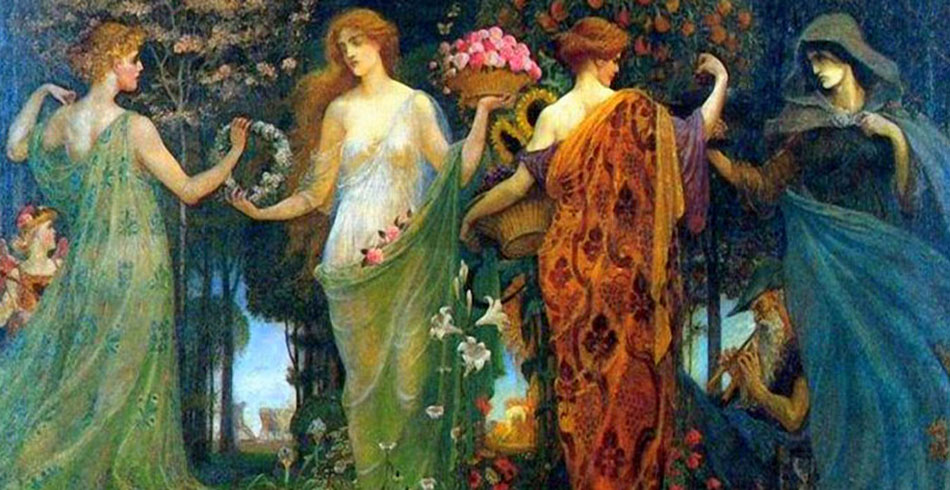
(Painting Credit: Walter Crane- The Masque of the Four Seasons)

Practical Experience

Can You Feel It?

This exercise is one that will be ongoing. The goal is to develop a sense of awareness as the seasons change and then apply that energy to deepening your celebration and connections to the Sabbats. We recently celebrated Lammas and the first harvest. Although this would by mundane standards be considered Late Summer, can you feel the stream of cooler air that is the undercurrent for even the most hot and humid of days? This was not there a month ago! Have you noticed that the flowers are beginning to pale in their vibrancy and there may even be some brown leaves forming on still very green trees? There is a specific smell to the Fall and the a certain feeling of internal body clock that begins to slow us down as we sleep a little deeper and become tired more easily. All in cycle with the slowing of life and growth as winter sets in and for some animals hibernation begins.

Now if you live in the Southern Hemisphere, you would be experiencing the reverse. The cold that has permeated is woven with gentle currents of warmer air and the freshness of Spring is already carried on the cold winds. You have celebrated Imbolc and the burgeoning light offering up thanks for the hearth fires of winter’s care and Brighid’s blessing of young animals, flowing milk and hope! Anticipation hangs deep in you and the desire to be out of doors makes you restless as you can almost taste the early summer air approaching.

These ways of opening ourselves to the cycles of the seasons, attuning to the astronomical events of equinox and solstice and aligning more fully with the Natural World. The more you pause to take note of these subtle changes the more expansive your sensorial vocabulary will become in knowing precisely where you are in the cycle, devoid of calendar and contrived seasonal parameters. If you have a camera, take pictures of what you notice. Keep a journal, dedicate a weekly contemplative practice to a walking meditation or outdoor being fully present.

A word to the wise…. Once you begin this process and establish those subtle lines of communication, it will never leave you in terms of being “awake and aware” of the world around you. You may leave the Wiccan Path for another spiritual journey. You may immerse yourself in technology, city and nothing constructed of the natural world, but there will always be the undercurrent of your natural self that “knows” the way of the seasons and the Sabbats. It will inform you even when you do not desire its knowledge and it will glow within you like a touchstone unlocking all the mysteries of your own sense of being. Enjoy!

1216274_55720839

Meditation

A Pathworking of the Season 

This pathworking will take you on a journey through the energy of the Sabbats as the Great Wheel Turns. This is yet another way of experiencing them with not all in the traditional format or way that is commonly celebrated.

How to use this pathworking:   Take a first read through just to familiarize yourself with the points of transition. I have them separated for the sake of your identification of the Sabbats; but the intent is for them to flow one to the other as you read through them in contemplative space.  Be sure to set aside adequate time to fully engage with the pathworking, preferably in a space that is not too noisy and where you will not be disturbed.  A handy trick with a pathworking such as this is to actually record yourself reading it through (slowly speaking in calm voice) and then play it back as you sit meditating.

Enjoy your journey!
A Pathworking of the Seasons


1361892160_mystical_eye_by_lukebaileyy-d4olpfo

Observation
Crafting Your Own Celebrations

There are as many ways to celebrate the Sabbats as there are those to celebrate them. My first suggestion is always that if you have access to a public/open ritual- go. Even if you are a Solitary Practitioner, this is an excellent way to experience first hand the way in which a group celebration is crafted and enjoy community as well.

There are several books available, some which are Sabbat specific that offer a complete picture of the energy, intent and suggestions for creating your own ritual. When I first began as a Solitary Witch, Scott Cunningham’s book- WICCA: A Guide for the Solitary Practitioner was my source of inspiration. I followed the rituals outlined and from those experiences learned alternate ways to make them more relevant and personal to what my intent was.  The other book that I often referred to was Laurie Cabot’s- Celebrate the Earth: A Year of Holidays in the Pagan Tradition.

A very simple way to begin a celebration tradition is to start with food. This is something that naturally connects you to the land from which you have gathered your ingredients (whether grocery store or garden) and the people you share it with. Crafts such as creating a cron dolly for Imbolc or Yule wreath for the Winter Solstice can serve as both seasonal decoration and have deeper meaning.  Altars are a wonderful way of setting up a space of celebration for the Sabbat and a simple ritual of lighting candles, enjoying a meal lovingly prepared with Seasonal foods and offering up gratitude that is in keeping wit the Spirit of the celebration can be very powerful ways to connect. As the seasons turn I’ll be offering bonus posts with ideas to incorporate into your celebration.

Remember that the celebration and devotion you offer up to the Path and the Gods and Goddesses you work with is within you. Everything else is simply icing on the cake.

More Sabbat Reading:

Yule: A Celebration of Light and Warmth by Dorothy Morrison

Imbolc: Creating New Pagan Family Traditions by Jodi Lee

Ostara: Customs, Spells and Rituals for Celebration of the Season by Edain McCoy

Beltane by Raven Grimassi

Midsummer: Magical Celebrations of the Summer Solstice by Anna Franklin

Lammas: Celebrating the Fruits of teh First Summer Harvest by Anna Franklin

Autumn Equinox: The Enchantment of the Mabon by Ellen Dugan

A Witch’s Halloween: The Complete Guide to Magick, Incantation, Recipes and Spells by Gerina Dunwich

Posted in YAD-Lesson Four, Year and A Day Course | Tagged , , , , , , , | 4 Comments

Pantheons

aphro
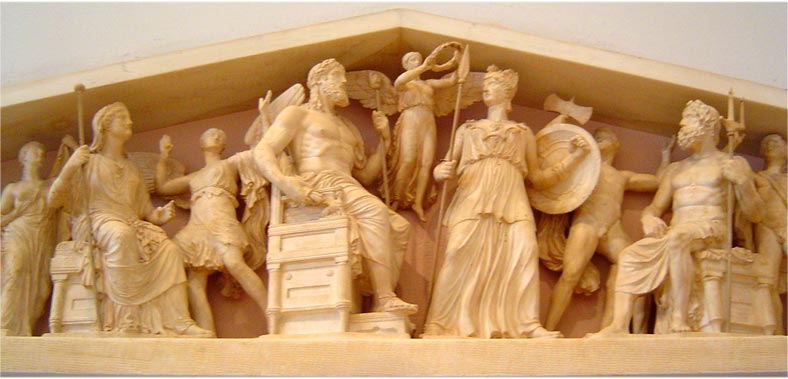
Aphrodite (left) Museum Collection: Musée du Louvre, Paris, France , Aphrodite Frejus”

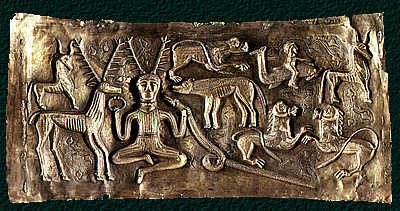
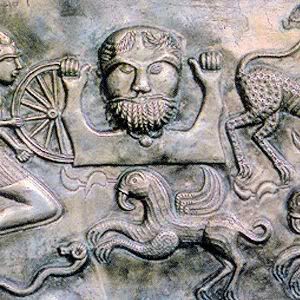
gundestrupcernunnos

Cernunnos (center) This image is derived from a carving on the Gunderstrup Cauldron, as well as other sources, however, I would like to note that Celtic scholar John Matthews in his book The Celtic Shaman states that he believes the image on the Gunderstrup cauldron to be that of a Celtic shaman and not the god Cernnunos.

By definition, the word Pantheon means……

  1. All the gods of a people or religion collectively
  2. (Especially in ancient Greece and Rome) a temple dedicated to all the gods.
  3. A group of particularly respected, famous, or important people

When we speak of Pantheons in a Wiccan Practice all of the above would be true. A specific pantheon chosen as the focus for regular working is generally of one collective whole; ie. Celtic, Greek, etc. As we offer up our devotion and honor these Gods and Goddesses in ritual and daily practice we are in essence becoming the Temple in which Deity is made sacred. And, most of the Gods and Goddesses were recognized as such because of the extraordinary feats and gifts that they exemplified.

Cultural Considerations

Wicca has its roots in the Ancient European cultures, therefore, many of the Gods and Goddesses that are honored are from those cultures. This is particularly true in the case of the Sabbats of the Wheel of the Year. Another pantheon that may be used is the Egyptian, either in the Egyptian form or in the later assimilated Hellenic forms ascribed to the major Egyptian Gods. So, where do you begin?

My thoughts would be to start from your own inherent pool of genetic memory in gathering information about the Gods and Goddesses. This is not to say that someone of German descent should not work with or explore a Greek Pantheon; but often taking a first look at the geographic area(s) that are part of your ethnic heritage will open the doors to finding which Deity(ies) you most naturally resonate with. Often embedded in the rich history of your own heritage are myths and stories that may awaken within memory of times long past and Deities that will reclaim your devotion.

Another suggestion would be to think back on what time of Ancient history you were most interested in as a young student. Did the Ancient Egyptians really capture your imagination? Were the Vikings and their Gods the tales you imagined? Did the exploits of the Greek Deities take hold or did stories of the mystical Isles and lands of the Celts inspire you to ask and question more?

Selecting a pantheon to regularly work with is largely a personal and selectively based choice. Your heart and intuitive response will lead you in the right direction if you are open and willing to follow.

Pantheons and Magick

zzywt9oh

Generally speaking, it is not wise to mix pantheons (cultures) when doing magickal workings. There is often a natural discord that will arise and just as each culture has its own style flavor and expectations of social proprieties, so too the Deities have their own parameters. We will discuss this more in future lessons. For example: If you were to write a ritual around the energies of Brighid, choosing the God, Lugh would be most compatible. Using Toth or Odin would not be the best choice.

Most importantly, do some research on the myths and the general cultural environment of the times during which a particular Deity was honored in a space of devotion or celebration. The more information you can bring to the process of creating effective communication and differentiation of the varying energies the Deities may exude the more likely you are to connect with those energies. For example, the Goddess Hestia * (of Hearth and Home) was typically honored and asked for blessing of a new home, during the preparation of meals and to keep the hearth fires burning strongly. The Goddess Persephone was called to bring the return of Spring as Hades, God of the Underworld and her husband allowed her to return to the Land of the Living for the greening of the earth.

The most commonly used Deities you will find in Wiccan ritual and celebratory work are those of the Celtic and Greek pantheons.

*Read More:  In Gratitude-The Lamp of Hestia

Please Note: This is the briefest and most basic overview of a subject that is extensive and would be well-suited to a course all of its own. As we continue with our lessons. I will be interjecting bonus materials that will include an overview of the Egyptian and Norse Pantheons.

The Celtic Pantheon

dagda
The Dagda

The Celts were inclusive of a variety of regions throughout Eastern Europe and encompassed lands stretching from the British Isles to Gallatia. Additionally, they had frequent interactions with those cultures that bordered their lands and as such held the potencies and cultural flavors of each within their own attribution of Deity. Within the Celtic Pantheon, many female deities were held in high importance, ranging from ruling, to mother to warrior goddesses. The Priestesses were highly revered and sang the dying to sleep, did charms, enchantments, prophecies, healing, etc. They knew the power of words, stones and herbs. One of the central features of their Groves was a cauldron, bowl or pool. Many of the Gods and Goddesses also held a tri-part nature.

One of the Major Clans of Celtic Deity is the Tuatha De Danann:

“In Irish-Celtic mythology, the Tuatha Dé Danann (“People of the goddess Danu”) are the Irish race of gods, founded by the goddess Danu. These gods, who originally lived on ‘the islands in the west’, had perfected the use of magic. They traveled on a big cloud to the land that later would be called Ireland and settled there…”The Tuatha Dé Danann” by Micha F. Lindemans. Encyclopedia Mythica

Important members of the Tuatha Dé Danaan are:

Dagda- The Good God; Ruler over life and death, Lord of Great Knowledge
Danu- The Mother of the Tuatha DeDanaans; Goddess of the land; Abundance; Wisdom and Teaching
Brigid(Brighid)- Triple Flame; Goddess of Healing, Poetry, Birthing and Smithing
Nuada- The Silver Hand;God of Healing; King of the Tuatha De Danaan; God of Battle
Lugh- Lugh of the Long Arm; Solar Deity; Skilled in All Arts
Dian Cecht- Physician of the Gods; God of Healing
Ogma- God of Eloquence and Learning; Speech and Language; God of the Bards
Lir- God of the Sea

Read More Here:
Timeless Myths: The Tuatha De Danaan

The Greek Pantheon

Golden Age of Ancient Greece B

The Gods and Goddesses of the Greek pantheons were very much akin to the humans who worshipped them. Most had traits and attributes that were quite human in nature and therefore very easy to identify with from a human standpoint. Unlike the Egyptian pantheon, these Deity were fully human in their appearances and were thought to frequently mingle among those of mortality. Many of these Gods and Goddesses were attributed to the energies of the planets and their natures were reflections of those cosmic entities in a form that was more closely connected to earth and the human realm.

These Great Gods and Goddesses were said to reside on Mount Olympus in Greece, and it was from this vantage point that all of human daily life and existence could be observed and on occasion interacted with.

The following list taken from a the Encyclopedia Mythica and Edith Hamiltons classic work “Mythology” gives a brief listing of some of the more frequently invoked Gods and Goddesses of the Greco/Roman pantheons:

Greek/Roman Name – Sphere of Influence

Zeus/Jupiter (Jove) – King of the Gods, God of Lightning
Father of the Gods
Hera/Juno – Queen of the Gods, Goddess of Marriage and Revenge
Poseidon/Neptune – God of the Ocean/Water, Brother of Zeus/Jupiter
Hades/Pluto – God of the Dead/Underworld, God of Wealth, Brother of Zeus/Jupiter
Ares/Mars – God of War/Strife/Wrath
Athena/Minerva – Goddess of Wisdom/Civilization,
Daughter of Zeus/Jupiter
Artemis/Diana – Goddess of the Moon/Huntress
Apollo(Helios) – God of the Sun, the Arts
Apollo (Sol) – God of  Healing, Music, Poetry
Dionysius/Bacchus – God of Wine,
Pan/Faunus – God of Nature
Hermes/Mercury – Messenger of the Gods
Aphrodite/Venus – Goddess of Love/Beauty
Hephaestus/Vulcan – God of Blacksmiths, Craftsmen
Hestia/Vesta – Goddess of Hearth and Home
Demeter/Ceres – Goddess of the Harvest

Read More Here:
The Pantheon: An Introduction to the Greek Gods

In Conclusion…

The work we have done this month was that of opening the lens of your idea of what Deity is and the connections that can be made beyond the formalized contemplative sitting or ritual. We inhabit the space of the Divine and it is present in all of our endeavors.

As we end our study of the Divine World and Lesson Three, consider establishing a regular practice of devotion to Deity. It does not have to be a specific God or Goddess. You can focus your intent on the archetypal energy. Preparing a meal can be dedicated to Hestia (Goddess of Hearth and Home) or providing food for the birds can be an offering to the Lord of the Green and Animals. And, in its most simple form, greeting the dawn of a new day with thanks to the Sun and ending each evening with gratitude to the Moon, seen and unseen for a restful night’s sleep in her starry arms.

259277b061e02b23a7205435632a2420

Look for the Divine in everything and as like attracts like you will be blessed with seeing the Divine in yourself.

Foundations of Practice: Observation
The Divine Surrounds
 

Resources: 

The Magical Pantheons: A Golden Dawn Journal (Bk.4) by Chic Cicero and Sandra Tabatha Cicero
Norse Mythology: A Guide to Gods, Heroes, Rituals, and Beliefs by John Lindow
Pagan Deities: Reference for Magickal Work & Devotion by Genna Morland
Egyptian Gods and Goddesses: The Mythology and Beliefs of Ancient Egypt by Clive Barrett
Rediscover the Magick of the Gods and Goddesses: Revealing the Mysteries of Theurgy by Jean-Louis de Biasi

Lesson Four Begins: August 1.2014

The Wheel of the Year

Posted in YAD-Lesson Three, Year and A Day Course | Tagged , , , , , , , , , | 4 Comments

The Divine Couple

wicca

We know of the need for balance in all things and the attraction of opposites that brings about the greatest changes and births something greater than the sum of its parts as a result. The recognition of masculine and feminine, God and Goddess is one that strengthens the foundations of following a Wiccan Path. This is the goal of acknowledging not only the feminine/Goddess-based energetics, but also realizing the need for the seed of the masculine/God to provide the catalyst and complete the cycle of creating new form that is both prevalent in nature and within our spiritual selves.

In working with these dualistic energies we are utilizing the streams of force (masculine principle) and form (feminine principle) that flow within us. When we call upon our feminine or Goddess natures we empower those parts of our self that are intuitively based; that align with the heart and serve to nurture. These are the energies that give form (the container of the womb) to the flow of force.

When we call upon our masculine or God-like nature we open to the strength and instinct for survival. This energy is that which aligns with the source of our courage and our connection with the density of the earth and its creatures. These are the energies of force (discharge of the seeds of insemination) that needs containment and direction of this dynamic outpour.

As these two energies coalesce and are brought to a place of equality in need and intent, the magick of exchange and the opening of heart is infused with instinct towards right action and informed productivity. The energies of great force are held within the structure of creative form and the resultant product is the creation of potent and life changing magick.(Sounds very much like, baby makes 3!)

Polarity

harmony

Each hovering within their own nature
Each compelled to seek the other for completion.

One containing the mirror
Divided yet equal while
Opposite yet united in
Discord and separation.

Splintered cells that once held
The magnetic nature of wholeness
And Graceful Duets Of Form And
Mass moving in rhythm guided
As curious travelers towards the
Destination of a harmonious soul.

This harmony exerts its cunning charms
And the similarities of spirit contained
Within each that calls itself one
Magnify and extend reaching beyond
Its true measure forcing the issuance
Of the scale’s final decree.

And what is the final discourse of this dual nature
In which all is bathed and purified to be reborn
In the shadow of its own reflection?

The final comfort taken in the vision of the
Opposing quality held in the supple vise of
The Divine’s Universal Law.

According to the Hermetic Laws:

The Principle of Polarity

Everything is Dual; everything has poles; everything has its pair of opposites like and unlike are the same; opposites are identical in nature, but different in degree; extremes meet; all truths are but half-truths; all paradoxes may be reconciled.

The Law of Polarity is the Universe filling what would be the void. It is the recognition of one state of being because of the acknowledgement of its polarized or opposite state of being. Each of these states being one in the same except for minute and un-observable differences which become more overt as the scale between each widens. Emptiness is the absence of fullness just as fullness is the absence of emptiness. They are both lacking in what the other has abundance of. Similar to the Principle of Correspondence (or resonance) like attracts un-like that is alike defined by the degree of its difference. 1.

It is a law of nature that all must have its opposite. And, as is played out in nature (the hermaphroditic animals), from the one, two shall be made to ensure continued life and the creation of a third force/form. In the realm of the Divine, the Limitless All becomes the two of God and Goddess and it through this polarity that we may find our return back to that Source.

The Great Rite

The Great Rite is the union of the God and Goddess as symbolized by the powerful energies of fertility and fecundity. It is magick in its most potent form as it draws from the seed of the phallic God and the catalytic womb of the Great Mother, combining those energies to manifest life giving energy. It is the affirmation of the act of creation and cycle of that creative force that flows through all of the Cosmos. This is the catalyst for manifesting form from the union of magnetic opposing energies.

imgres

In ritual magick the Great Rite may be symbolically carried out in representation of the magickal tools of the athame (phallus/masculine) being submerged into the chalice (womb/feminine). Traditionally this is performed by the High Priest and the High Priestess as God and Goddess (or those members within the ritual who have invoked the God and Goddess) and accompanied by the statement (or slight variation upon):

As the chalice is to the woman (High Priestess)
And the athame is to the male (High Priest)
So their union is in perfect Love and perfect Trust (both together)
So Mote It Be!

This signifies within the ritual space that the combined and polarized energies of God and Goddess are working through the magick that has been called into being and the union of those energies will insure that all present and future workings will be fruitful and blessed.

In certain circumstances, The Great Rite may be performed by way of the actual physical act of sexual intercourse. This practice is used as a component of sex magick or sacred Tantra. It is not specific to a Wiccan practice and is generally not used as part of routine ritual work. Because of the intimate nature and ethical issues surrounding this form of practice, the participants should never be underage, unwilling partners or more importantly simply complying with the wishes of the leadership of a coven or other group. Some couples who routinely work as magickal partners will use the literal interpretation of The Great Rite as a means of combining their energies towards more potent manifestation of the magickal work they are undertaking. In the case of sacred Tantra, historically, the priestess and priest were specifically trained in the techniques of retaining and building the founts of raw energy produced during sex and then at the appointed time culminating that release in an energetic wave towards specific healing and renewing workings.

The Wheel of the Year

imgres

The Witch’s Wheel of the Year includes eight Sabbats that are celebrated throughout the course of a year. Each of these Sabbats weaves the cycle of exchange between the energies of the Goddess and the God; each bringing forth one of the Triune patterns- Maiden/Youth- Mother/Father or Crone/Sage.
As we move through the Wheel the Divine Couple merge, blend, interact one upon the other and sustain creation. We will study more about the specifics of God and Goddess in our next lesson. The most commonly known Sabbat that exemplifies the Sacred Union of the Divine Couple is that of Beltane.

Beltane occurs seasonally just after the Spring Equinox. It is the time of union of the Goddess as Maiden and the God as Youth. It marks the time of the strengthening of the solar energies and the response of the Goddess as consort, lover and fertile womb for the quickening of new life. The maypole is commonly used in this ritual and signifies the potency of the phallus and the life that will issue forth from its seed. The earth, in which the erect maypole stands is the womb of the sacred feminine and as we dance round the maypole, weaving the energies of the colored ribbons we are weaving the energy of conception and the exciting and stimulating of the sperm and the receptive opening of the cervix.

We will learn more of the Divine Couple and the use of the masculine and feminine within to call forth the creation of the Divine child of life that is an aspect of our being.

Foundations of Practice:
Meditation: Sitting with Deity

Resource:
1. The Kybalion by the Three Initiates

Next Week’s Post
Pantheons

aphro

Posted in YAD-Lesson Three, Year and A Day Course | Tagged , , , , , , , , , , | 1 Comment

Meditation:Foundations of Practice-Lesson 3

imgres

Sitting with Deity

A Meditation of Opening

This week’s focus is on simply opening to connect with Deity. If you have a specific Deity you wish to connect with or already have connection to, focus your intent on simply “being” with this Divine energy. For this meditation we will not be asking for guidance or any specific request. The intent is to sit quietly and open to whatever Deity wishes to present us with. Let’s begin:

Select a space where you will not be disturbed and is as quiet as possible. Sit comfortably and begin to take notice of your breathing. Listen deeply to the sounds as you inhale and exhale and even the rustle of clothing as belly and chest expand. Take note of the sensation of the air filling your lungs and the sense of fullness than emptying that occurs as you inhale and exhale. Now, take notice of the smells that come into your nose as you breath a little deeper still, and the release of that aroma as you exhale it back out. Continue this pattern of sensorial awareness for several minutes.

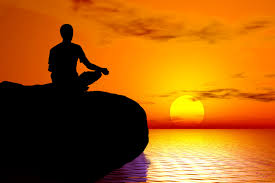
Now, allow your breathing to be secondary in focus and shift your awareness to the space between your brows, the seat of your inner screen. Draw all of your attention into this space and envision a small point of white light at the center of your awareness. As you gently breathe and bring more attention to this space of visioning, the point expands and soon there is nothing but a brilliance of white light filling this inner space. Take a deep breath in and as you exhale see your physical form stepping into and through this brilliance of light and find yourself standing on a mossy rock surround partially surrounded by water. You look out at the glory of a beautiful sunset and lower yourself to a sitting position on the edge of the large stone. You breathe deeply and as you exhale you feel an opening of your perception and a peace and calmness that is profound in its presence.

As you sit in the stillness of this landscape you offer up the invitation to commune with the Divine. You offer up the willingness to listen deeply to what may be given and to allow yourself to simply be held in the space of Deity’s presence. You breathe deeply and as you exhale you allow your mind to be still of thoughts, your heart to be welcoming and sit “waiting”.

As you quietly sit, allow yourself to sink as deeply as you wish into this cradling of stillness, unhurried and patient for response. When you feel complete, offer up gratitude for the experience that you had (even if you feel “nothing happened”). Offer up gratitude to yourself for being able to reach this space of stillness and presence.

You gently rise to a standing position and see that the sun has set and moonlight shimmers on dark moving waters. Take a moment to take this image into your being and the beauty of the quiet. As you continue to look out across the waters and breathe into this experience the landscape gently fades and you find that your awareness has returned to being that of the observer; your focus on your inner screen. Breathe deeply into this awareness and shift in perception and the comfort this space provides.

Gently allow your awareness to return to that of filling the space of your entire being and the physicality of your body and breath. Turn your focus back to the rhythm of your breath and the gentle rise and fall of your chest and expansion and contraction of your belly. Breathe fully and deeply allowing this energy to reawaken all of the physical sensations of being fully present in the space in which you began this meditation. And, when you are ready, gently open your eyes, returning to the here and now.

Note: Do not be discouraged if you feel that Deity did not respond. ONE of the goals of this practice is communing with deity, but an equally important goal is that of preparing the way so that you are fully present and listening to the message. Communing takes many forms and it is not always the clear-cut epiphany moment that occurs.

We are constantly in communication with the Divine, but rarely are still enough nor open enough to receive what is being communicated. Engaging a stranger in a reciprocal smile is communing with the Divine. Having the perfect parking space open and available after a trying commute is communing with the Divine. Having a pleasant day at work and the opportunity to relax when you get home is communing with the Divine.

Bring this level of awareness into your contemplative practice with full intent and after not such a long time, you will recognize Deity in all of his/her forms as you sit in the silence of their wisdom. More importantly, this level of awareness will spill over into your everyday experiences making magick of the mundane.

Real-Life Experience:

Check out my Summer Weekend in the Parks post on The Enchanted Gate Blog. Surrounded by all that beauty, I could feel the blessings of the Divine as my husband and I became the Divine Couple.

Return to Foundations of Practice: Lesson Three

Posted in YAD-Lesson Three, Year and A Day Course | Tagged , , , , , , , , | 2 Comments

The God – The Youth

il_570xN.323627042
Image: Emily Balivet

Solar Cycle
Dawn

The God in his form as the Youth correlates to Dawn. This is the energy of the renewed cycle of Light and the birth of the God at Winter Solstice heralds the waxing light half of the year. Hope abounds and the God as sun-child carries into the world the spark of flame that will grow stronger with each passion day, as does he.

The Dawn begins the day offering its energy to begin the process of what will mature and expand as the light increases and the hours pass. So too the God grows quickly and with confidence as he becomes the King of the greening Oak. As the bearer of the spear of Lugh this youth proves his prowess and all that is within his aim is pierced by the impetuosity of youth.

The God grows in strength and so does the power of his light to quicken what now lay within the bounty of the Earth Goddess. His is the greening that calls to life the young animals and his is the face that lay camouflaged in the buds of spring green leaf.

When we think of the God as the Youth we envision the boldness of the young man, the sexual appetites and fecundity of the young buck and the confidence and virility to make his own what he most desires. His is task of becoming companion and eventually consort to the Goddess who has now also renewed and transformed into the vessel that is the Maiden that will consummate the Divine Union that joins them as one.

His are the strong arms that hold you passionately within his fiery embrace. His is the union of ecstasy that calls you to him in reminder of your own passions of youth and desire. His is the phallus whose seed generates new life that will come to term within the belly of his lover as they become Father and Mother.

Colors: Bright vibrant Green/Rich brown/Tan

Sabbats:
Yule- The Oak King
Imbolc- Lugh
Ostara- Lord of the Green
Beltane- Belanus/The Horned God

The Mystery of the God

The Father
The Sage

Posted in YAD-Lesson Three, Year and A Day Course | Tagged , , , , , , , | 3 Comments